
While much attention has been devoted to interest rates and industrial revival, the bigger problem for the economy could be its external vulnerability.

'Rhetoric and chest-thumping are running high on India's recent growth record.'
'But will the giant waves developing elsewhere allow us to sail smoothly into fair winds?' asks Debashis Basu.
The 30-share Sensex declined 590.05 points or 3.18 per cent to close at 17,968.08 and the 50-share Nifty dropped 189.05 points or 3.45 per cent at 5,287.45 levels.
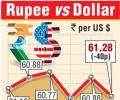
Rupee has lost close to 16 per cent this year making it one of the worst Asian currencies so far.

If growth reverts to the pre-Covid level, a lot of people may have to temper their rosy optimism, points out Debashis Basu.

The central bank is of the view that rise in external debt a concern but rating outlook revision reassuring.
NRIs will abandon rupee-denominated accounts, causing a deposit crunch and worsening the current account deficit.

Petrol and diesel prices on Tuesday touched fresh highs as rupee dipped to a record low of 71.54 against US dollar, making imports costlier
According to a report by German banking giant Deutsche Bank, a weaker Indian rupee has allowed India to remain the cheapest major economy in the world despite persistently suffering the highest inflation rate.

India Ratings on Mondy projected a 7.7 per cent growth this fiscal driven by consumption demand.
Chidambaram on Monday sought to soothe nerves about its external finances by promising to contain the current account deficit at 3.8 percent of gross domestic product this fiscal year with a slew of measures including easing rules for raising loans abroad.

Also, the import tariff value -- the base price at which customs duty is determined to prevent under-invoicing -- in case of silver has been reduced to $644 per kg from $694 per kg earlier, a notification by the Central Board of Excise and Customs said.

CAD, which is the difference between outflow and inflow of foreign currency, touched a historic high of 6.7 per cent in the third quarter.
The Reserve Bank of India (RBI) has slashed the repo rate by 25 basis points from 7.75 per cent to 7.5 per cent with immediate effect.
It says RBI may have to continue raising rates; prescribes floating sovereign bonds, going for NRI forex swaps again.

Experts feel oil prices will remain volatile with an upward bias.

After the government sought Parliament's nod for a second batch of supplementary demand for grants that will cause a hit of Rs 2.99 trillion to the exchequer, doubts suddenly arose about the government's ability to meet the Budget projections of reining in its fiscal deficit at 6.8 per cent of gross domestic product (GDP), or Rs 15.06 trillion, for the current financial year. Till now, many were of the opinion that the government would succeed in checking the deficit at a much lower figure than what was given in the Budget Estimates (BE). The government had sought Parliament's approval to spend Rs 3.74 trillion extra, but Rs 74,517.01 crore will be matched by equal savings on other heads.
Ask rediffGURU and PF and MF expert Janak Patel your mutual fund and personal finance-related questions.

The macroeconomic environment has changed dramatically for the better.

'Probability has increased for India to have improved fundamentals'.

On its part, the Reserve Bank of India tried to help exporters by easing some restrictions imposed on holders of Exchange Earners Foreign Currency accounts and by giving effect to the commerce minister's announcements regarding extension of the interest subvention scheme for one more year and for more items.
While retaining India's sovereign rating at 'BBB-' with a negative outlook, S&P said there is at least a one-in-three likelihood of a downgrade within the next 12 months.

India's gold and silver imports from its free trade agreement (FTA) partner UAE have skyrocketed 210 per cent to $10.7 billion in 2023-24 and there is a need to potentially revise the concessional customs duty rates under the pact to mitigate the arbitrage driving this surge, a report said on Monday. Economic think tank Global Trade Research Initiative (GTRI) said this sharp rise in gold and silver imports is primarily driven by import duty concessions granted by India to the UAE under the India-UAE Comprehensive Economic Partnership Agreement (CEPA).
Rajan also did his bit by taking steps to protect the currency against speculative attack as did the government in curbing gold imports and bringing the Current Account Deficit
Bhavtosh Vajpayee, managing director and head of the Indian equities business at Barclays, the London-headquartered multinational banking and financial services company, tells Business Standard it is still too early to predict an economic recovery.
While the country imposed limits, it also eased and simplified other restriction to attract foreign inflows. This is done to plug record current account deficit.
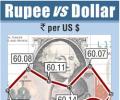
Forex dealers said besides dollar's gains against the euro overseas, increased demand from importers for the US currency and a lower opening in the domestic equity market also put pressure on the rupee.

Currently, non-residents visiting India are not allowed to take out any Indian currency while leaving the country.
For the last few years, the assumption in much of the economic discourse has been that India is on an assured path of rapid growth.

The country's CAD stood at 5.4 per cent of GDP during April-December period of financial year 2012-13 amounting to $72 billion.

The rupee is likely to strengthen to 60-61 level by this fiscal-end on expectations of improvement in current account deficit (CAD) and higher inflows from overseas investors.

Indian markets may see some weakness in stocks post Fed hike.

India's trade account could come under pressure and there could be an inflation push if crude oil prices remain above the $90 per barrel (Brent) for a prolonged period since India imports over 85 per cent of its oil and roughly 50 per cent of its gas. A rebound in economic activity is bound to lead to higher fuel demand. While India is the third-largest importer of crude, it is a net exporter of refined products, which helps to compensate to some degree.
Morgan Stanley on Monday raised India's growth forecast for the current financial year to 5.4 per cent from 5.1 per cent projected earlier citing better than expected GDP growth in the September quarter and stabilisation in non-agriculture growth indicators.

India's current account deficit, which is the excess of foreign exchange outflows over inflows, touched a historic high of 4.8 per cent of GDP in 2012-13, mainly due to rising imports of gold and petroleum products.
Rapid depreciation of the rupee put us in a vicious spiral: D Subbarao

We only correct the volatility of the rupee, he said.

Global rating agency Standard and Poor's on Wednesday cautioned that large deficit economies including India could face more economic problems in the near term.
.jpg)
The depreciation of the rupee, it said, reflects the wider CAD as well as lower net capital inflows.
 © 2026 Rediff.com - Advertise with us - Disclaimer - Privacy Policy - Sitemap - Feedback - About us - Terms of use - Grievances